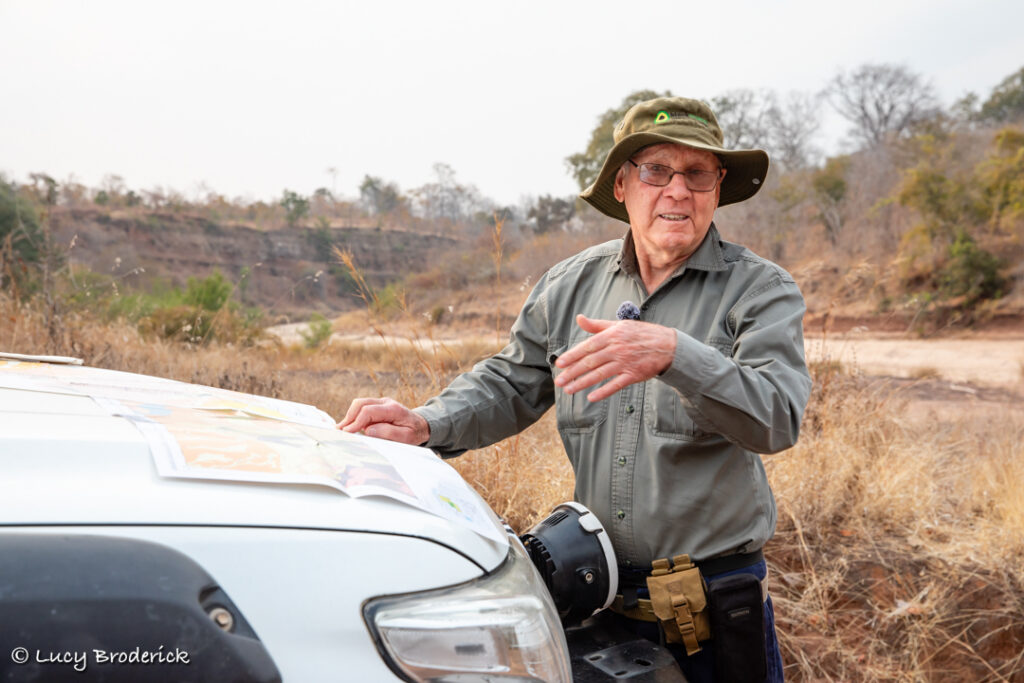
Chenje Camp is quiet just after dawn. Geologist Tim Broderick climbs into a Land Cruiser heading for a spectacular dinosaur trackway he first documented more than four decades ago. He’s been back many times but this time it’s to pass on his knowledge to a team of learner guides.
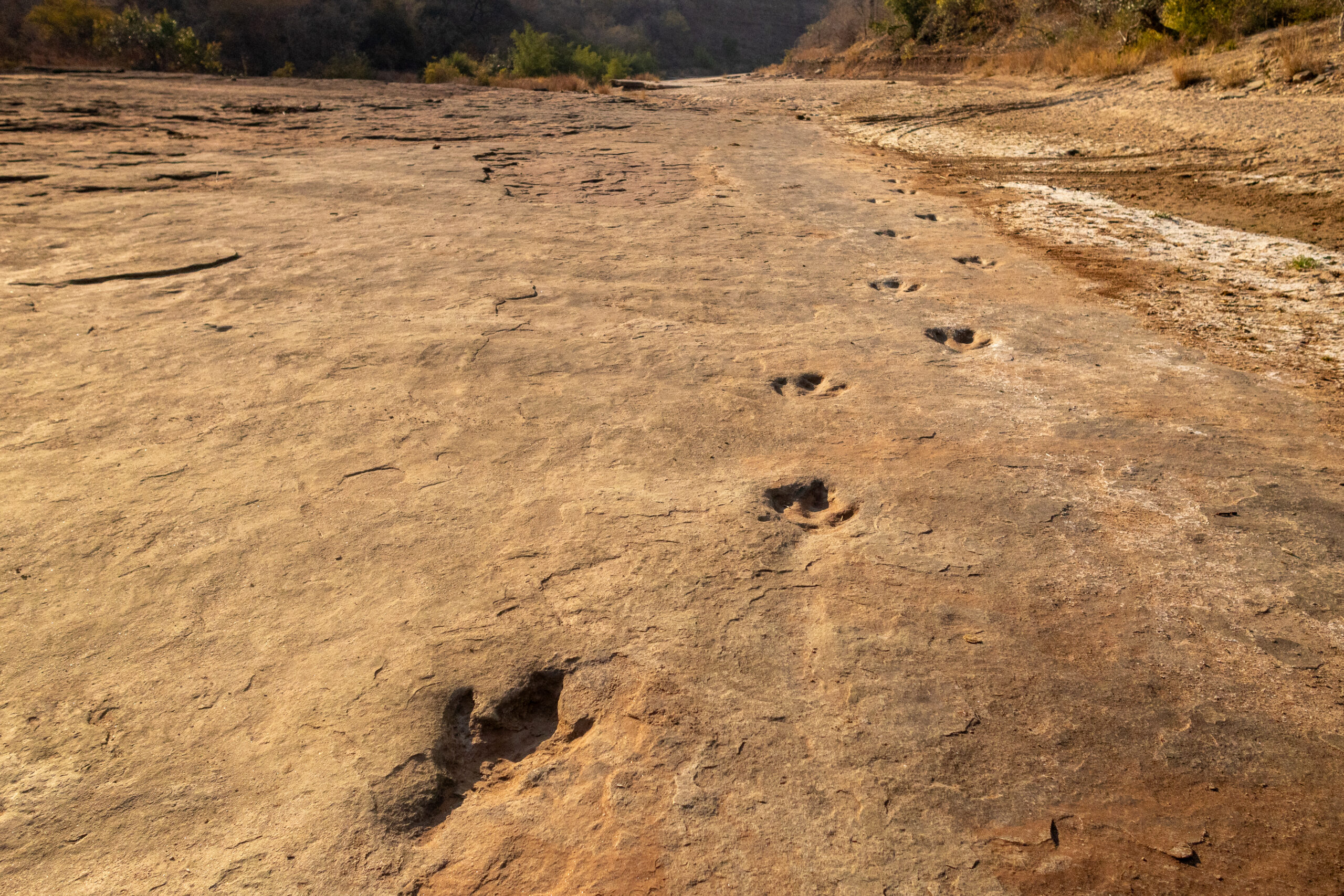
The camp is a former hunting property on the Chenje River but has recently reopened as a spectacular photographic safari destination run by the Chewore Conservation Trust. Amid the wild and remote landscape, with its myriad biodiversity from elephant and lion to antelope and buffalo, lies stunning evidence of a prehistoric past. Here you can stand in the very footprints of giant dinosaurs that roamed in the late-Jurassic, some 140 million years ago. It is real ‘Jurassic Park’.
Back at the trackway
Broderick first documented the Ntumbe Dinosaur Trackway with his wife, Trish, in 1984. Forty-two years later, on the day of his 77th birthday, he’s returning with his daughter Lucy and two learner guides from Chenje Camp. He recalls arriving here all those years ago as a 35-year-old Geological Survey geologist working in intense November heat.

“There were originally 14 prints exposed on this rock pavement, and we set about revealing them from under the sand cover and working out their morphology, what their pace and stride were,” Broderick says. “We measured them together with my wife, who is an artist, and we recorded this section of the trackway. After Operation Raleigh Venturers in 1990 trenched back into the alluvium, we later found there were 45 prints in total.”
He remembers they didn’t have enough plaster of Paris to cast every print.
“We only had enough to cast one left footprint and one right – but enough, since the animals were bipedal, to record how they walked.”
The Discovery
In 1984, Broderick was guided then by a young 26-year-old officer from the Department of National Parks and Wildlife Management [now ZimParks], Lovemore Mungwashu. Awe Nature later tracked down Mungwashu, who was Officer-in-Charge in Chewore South in the 1980s and remembers that the discovery began by accident.

“At the time of discovery of the footprints, I was accompanying a hunt being conducted by Mr John Tolmay, who was the professional hunter, and his Australian client, Mike Aldersey,” Mungwashu says. “Yes, it is the Australian client who discovered the footprints and called us all to have a look. I then wrote to the National Museum telling them about this sighting,”
The wider Chewore area contains several footprint sites along the Ntumbe River, including tridactyl Allosaurid tracks and giant Sauropodomorph footprints. The area has also revealed fossils of ancient freshwater fish, like Lepidotes, as well as tiny freshwater crustaceans known as Conchostracans.
“It really is a tremendous glimpse in time into the late-Jurassic around 140 million years ago,” Broderick said. “But you have to really work to get there, Chewore is one of the wildest places in Zimbabwe. But it’s well worth the effort.”
A Family Trade
Broderick’s daughter Lucy has been coming on field trips with her father since she was a child.

“You wouldn’t notice a difference in the way he taught me about palaeontology and geology and the way he teaches other groups during his visits,” Lucy says. “He’s very passionate about his field.”
Lucy, who holds a Fine Arts Photography degree, carries a hammer on the walk to show scale against old and new finds. She also has brushes for clearing sand from footprints and a camera to record the fossils and her father at work.
At times, she prompts her Dad when a detail slips his memory. At other times, she’s the one teaching the group.

“I have been there so many times now. Every time we find something new,” she says. “The knowledge just rubbed off on me because I followed my dad on all his trips. I found my first bone when I was about eight years old, at Kariba – it was a bone from Vulcanodon karibaensis, a long-necked plant eating dinosaur, a Sauropod that lived around 180 million years ago.”
Dinosaur Nursery
Among the sites is a cluster of very small footprints thought to be a dinosaur nursery site.
“Here the footprints measure about 3cm across, running this way and that, a bit like a chicken run,” said Broderick. “The general conclusion is that this was probably a nursery. Very different from the biggest tridactyl prints which are 43cm from heel to toe!”
Guide Discovery
Mackenzie Zirota, one of the Chenje Camp learner guides on the trip, grew up in Mbire Ward 11, a community bordering Chewore South Safari Area. Within 24 hours of lessons with Tim, he had found a fossil fish along the Ntumbe River and a dinosaur fossil along the Maura River – one he jokingly named ‘Mackenzie maurasaurus’.

“I learnt the trick of how to find fossils on the rocks, or fossil fish,” Zirota says. “Yesterday, when I was looking on the rocks, I found my own fish bone. When we walked up a river, I found a dinosaur fossil, but I learnt that it was already discovered on previous visits by other groups!”
“It’s not something very hard but you need to know where to look, where to put your eyes. Otherwise you’ll just walk past these things.”
Tim’s lessons also corrected something Zirota had believed for years.
“We used to think the fossils near Mana Angwa were the same age as the footprints – 140 million years,” he says. “Now we’ve learnt it’s about 200 million years old, while the footprints are much younger.”

Passing On the Knowledge
Zirota fished along the Angwa River as a child in the mid-1990s, not knowing what lay in the rock around him. He wants to make sure others in his community do not grow up the same way. Zirota has a three-year-old son of his own, and plans to pass this knowledge on to him too – the same way Broderick has passed his own knowledge down to Lucy.
“Without knowing, people may destroy the fossils, thinking they are bones of some other animal, without understanding how these things came to be,” he says. “Once the community understands the importance of fossils, they will understand that the visitors coming through Chewore are helping us – and the more visitors come, the more indirect benefit we get as communities.”
What this means for Chenje

Chenje Camp reopened to visitors in June 2026 after a full refurbishment of a site that once served as a base for trophy hunters. It is now managed by Chewore Conservation Trust, with proceeds supporting the protection of the area which forms part of the Mana Pools–Sapi–Chewore UNESCO World Heritage Site.
Guests staying at Chenje can now experience something wholly unique. Guides can show them an abundant living population of wildlife, as well as giving a glimpse into the deep distant past where dinosaurs once roamed and left their own mark. And what’s more, there is no doubt new discoveries are there, just waiting to be found.
CCT is Awe Nature’s implementing partner in Zimbabwe, managing the 200,000-hectare Chewore South Safari Area under a 25-year collaborative management agreement with the Zimbabwe Parks and Wildlife Management Authority (ZimParks).
Please Note: Fossils are protected by law and must not be collected casually. New finds must be reported to the Natural History Museum in Bulawayo. They potentially represent an important scientific discovery and need to be properly excavated and documented.