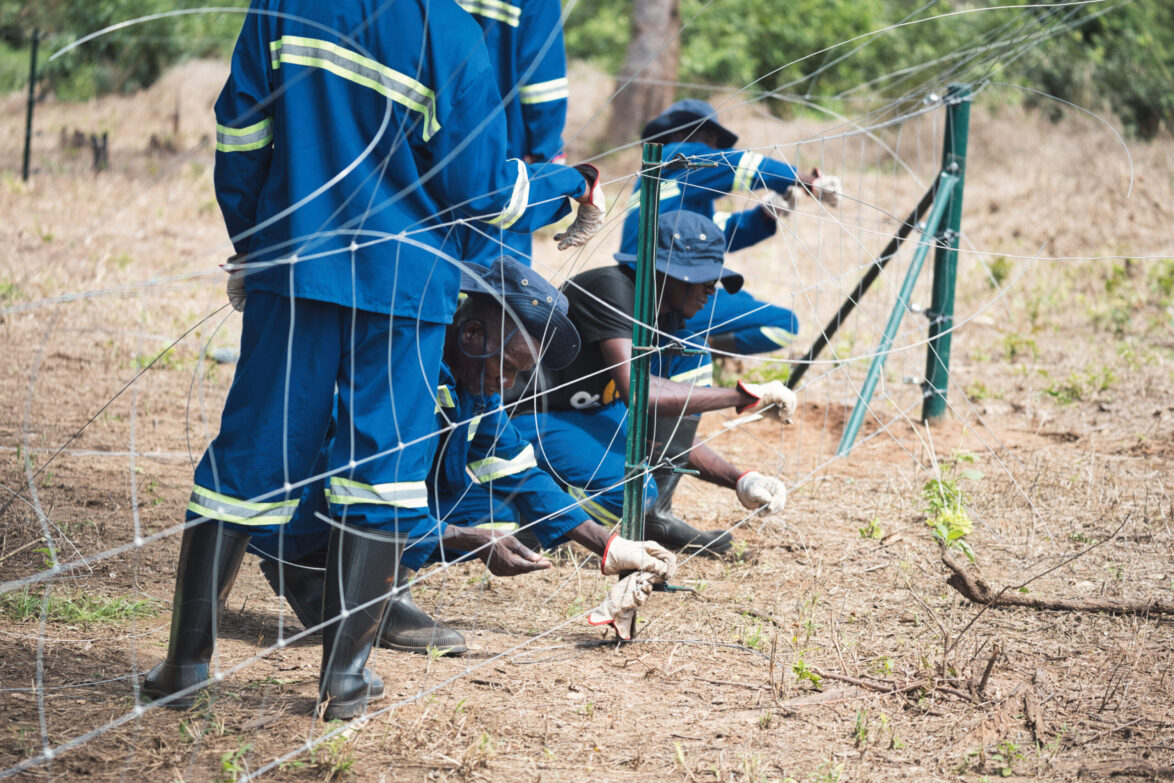
A 22 km elephant- and predator-proof fence is rising around the community of Masoka in Zimbabwe’s Zambezi Valley – and in May 2026, senior leadership from the Awe for Nature Foundation (Awe Nature), the Chewore Conservation Trust (CCT), and the Zimbabwe Parks and Wildlife Management Authority (ZimParks) visited the site to assess progress on this and other human–wildlife conflict mitigation projects being delivered on the ground by CCT.
Masoka is a community in Zimbabwe’s Mbire District, located in the Zambezi Valley adjacent to Chewore South Safari Area – part of a UNESCO World Heritage Site and one of Africa’s last intact wilderness ecosystems. With a proud Communal Areas Management Programme for Indigenous Resources (CAMPFIRE) history, the community has long lived alongside some of Zimbabwe’s most important wildlife populations, placing them in the path of human–wildlife conflict.
The Awe Nature and CCT board and senior leadership, joined by ZimParks Director of International Conservation Affairs Professor Patience Gandiwa, toured two key sites: the Masoka elephant- and predator-proof fence currently under installation, and the Masoka solar-powered piped water scheme.
A Community-Led Fence Against Human–Wildlife Conflict

Following an assessment conducted by CCT with external consultants in 2025, it was established that the Masoka community had been incurring annual crop and livestock losses of approximately USD 300,000 as a result of human–wildlife conflict.
In response, the community proposed the installation of a protective fence around their settlement. CCT set this plan in motion by signing a Memorandum of Understanding with the Mbire Rural District Council, paving the way for the current installation.
CCT has since commenced the installation of a 22 km elephant- and predator-proof fence around Masoka – one of its flagship interventions in the landscape. In a demonstration of strong community ownership, ten residents were selected by the community itself to form part of the installation team, with others contributing through land clearing and patrols by community wildlife scouts.
As of 5 May 2026, 8 km of fencing had been erected.
Dave Mhande, Masoka Village Headman, welcomed the progress, noting that each village head had been allocated 1 km of fence to oversee throughout the year.

“The community is happy because of the fence installation underway. Whatever we are required to do as a helping hand, we are on standby – because we are the ones being assisted,” Mhande said.
Professor Patience Gandiwa, Director of International Conservation Affairs at the ZimParks, commended the project as a tangible expression of Zimbabwe’s broader conservation and re-engagement agenda.
“We are grateful as ZimParks that this amazing work, undertaken in partnership with CCT, is firmly in line with Zimbabwe’s re-engagement agenda,” she said.
She added: “We are an agent for the protection of our wildlife heritage – and where we have constraints, the highest offices speak of partnership and collaboration. We cannot protect these animals without you and our partners. Without that, we will fail.”
Expanding Access to Safe Water

In April 2026, CCT completed the second phase of the Masoka solar-powered piped water scheme, installing three additional 5,000-litre tanks to bring total storage capacity to 20,000 litres – significantly expanding the volume of clean water available to the community.
This followed the completion of Phase 1 in December 2025, which marked one of CCT’s first projects designed to provide a clean and nearby water supply to Masoka.
During Phase 1, CCT – working in partnership with the Mbire District Development Fund (DDF) Water Department – helped identify and verify a borehole site selected by the community. The borehole confirmed a high-yield water source capable of meeting the needs of people, livestock, and small domestic use. Community members then led the digging of approximately 13 km of pipeline trenches to bring water safely into the village.
Professor Gandiwa underscored the human cost of the crisis that the water scheme is helping to address.

“In the past five years, we have lost almost 390 lives to human–wildlife conflict. Thirty-eight percent of those deaths were due to crocodiles – and we know crocodiles are in water. When water is made available to people close to home, you can imagine the difference that makes,” she said. “At national level, crocodiles have consistently topped human–wildlife conflict statistics, followed by elephants.”
Promotion Dzomba, Masoka Ward Secretary and Village Head, described what the water scheme has meant for daily life in the community.
“We used to walk 7 km to the nearest water source and encountered wildlife along the way. We are happy because women are now fetching water at safe distances of 1 km or less,” said Dzomba, noting that families now have more time together – time previously lost to the daily burden of fetching water.
Awe Nature Founder and Chief Executive Officer Michael Hacking reflected on the significance of the visit and the partnerships that have made this progress possible.

“This is just the beginning. We are grateful to ZimParks for trusting us with the stewardship of this area – it is their support that has made our work with this community possible. Knowing that what we are doing is valued and appreciated is what keeps us going,” he said.
About Awe for Nature Foundation
Awe for Nature Foundation is a non-profit organisation advancing practical, scalable finance solutions to support the long-term protection of critical ecosystems and help shape a new model for conservation. Our mission is to deliver high-integrity nature finance solutions in real-world conservation settings. Through long-term partnerships on the ground – beginning in Zimbabwe’s Protected Area Network – we aim to create scalable models that protect biodiversity, support livelihoods, and inform the future of global conservation finance. As the founding partner behind the Chewore Conservation Trust, Awe for Nature Foundation provides strategic, technical, and financial support to conservation efforts in the Chewore South landscape.
About the Chewore Conservation Trust
The Chewore Conservation Trust (CCT), a flagship project of the Awe for Nature Foundation, is a Zimbabwe-based conservation organisation working to protect and restore the Chewore South Safari Area in the Zambezi Valley. Operating under a 25-year-long-term collaborative management agreement with the Zimbabwe Parks and Wildlife Management Authority, CCT leads wildlife protection, habitat restoration, community development, and sustainable livelihood initiatives across the landscape.
Media Contacts
For more information and to arrange interviews, please contact:
Michael Hacking, Awe for Nature Foundation Founder and Chief Executive Officer —michael.hacking@awenature.org
Niall McCann, Awe for Nature Foundation Conservation and Communications Executive Director — niall.mccann@awenature.org
James Egremont-Lee, Awe for Nature Foundation Country Director — jegremontlee@awenature.org